How Do Microservices Talk to Each Other Without Getting Lost?
Published on November 16, 2026 | Category: DevOps
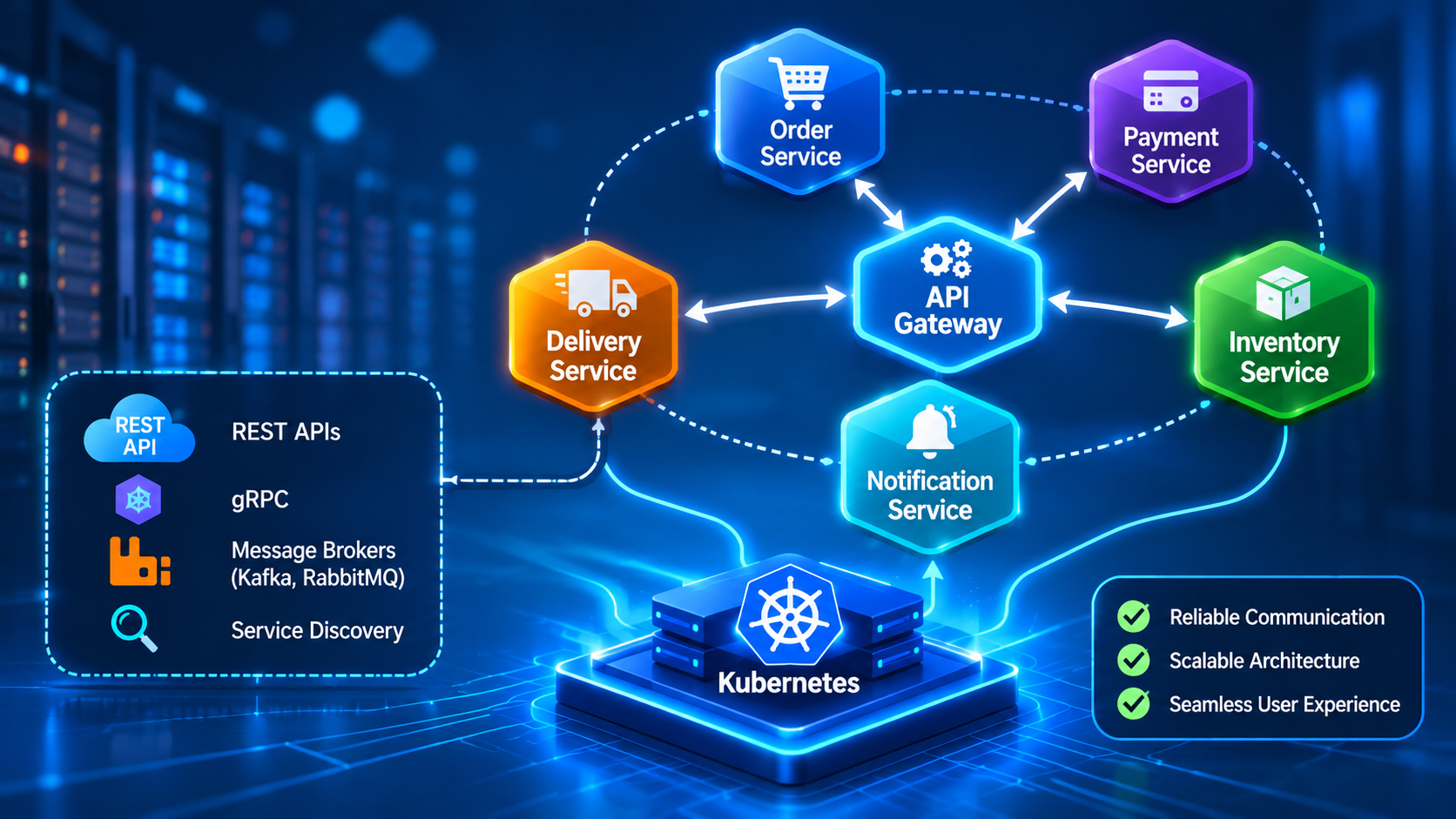
Imagine ordering a pizza online. You place the order, make a payment, receive confirmation, and eventually get your pizza delivered. Everything feels like one smooth experience.
Behind the scenes, however, several independent services might be working together: one handles orders, another processes payments, another manages inventory, and another coordinates delivery.
These services don't necessarily share the same codebase or run on the same server. They operate independently, yet they must exchange information accurately and efficiently.
So, how do they communicate without confusion, delays, or lost messages?
Welcome to the fascinating world of microservices communication.
What Happens When Microservices Need to Communicate?
Microservices architecture divides an application into smaller, independent services, each responsible for a particular business function. But independence doesn't mean isolation.
An order service may need payment confirmation from a payment service. A payment service might require customer information from another service. Meanwhile, an inventory service needs to know when an order has been placed.
This constant exchange of information is what makes a distributed application function as a unified system.
The challenge? Every service might run on a different machine, use different technologies, or operate at different speeds.
That's why Container & Microservices Services rely on communication mechanisms designed to help independent components exchange information reliably.
REST APIs: The Digital Waiter Between Services
One of the most common ways microservices communicate is through REST APIs.
Think of an API as a waiter in a restaurant. You don't enter the kitchen and prepare your meal yourself. You place an order through the waiter, who communicates with the kitchen and brings back the response.
Similarly, one microservice sends an HTTP request to another, and the receiving service responds with the requested information.
For example:
The order service requests payment processing.
The payment service validates the transaction.
The payment service returns a success or failure response.
The order service updates the order status accordingly.
REST APIs commonly exchange data using JSON, making communication straightforward across different programming languages.
However, REST isn't the only option. Some applications use gRPC, which enables efficient communication through strongly defined service contracts and Protocol Buffers. It is particularly useful when services require high-performance communication or streaming capabilities.
Synchronous vs Asynchronous Communication: Should Services Wait or Keep Moving?
Microservices don't always communicate in the same way.
Sometimes, one service must wait for another to respond. In other situations, it can send a message and continue working.
Synchronous communication
In synchronous communication, a service sends a request and waits for a response before proceeding.
For example, when checking whether a username is available, an application might immediately contact the user service and wait for confirmation.
This approach works well when an immediate answer is necessary.
The downside? If the receiving service becomes slow, the calling service may also experience delays.
Asynchronous communication
Asynchronous communication allows services to exchange messages without requiring the sender to wait for the receiver to complete its work.
Imagine placing an online order and receiving a confirmation immediately while the system processes notifications, analytics, and other tasks in the background.
The order service can publish an event such as “Order Placed,” and interested services can process it independently.
This improves flexibility and reduces unnecessary waiting.
However, asynchronous communication introduces challenges such as message ordering, duplicate processing, and eventual consistency. These require thoughtful design rather than simply sending messages and hoping everything works.
Message Brokers: The Post Office of Microservices
What happens when one service needs to communicate with several others without directly contacting each one?
This is where message brokers become useful.
A message broker acts like a digital post office. A service sends a message, the broker receives it, and other services can consume it according to the communication pattern being used.
Popular technologies include Apache Kafka and RabbitMQ.
Consider an online shopping application:
When an order is placed, the order service publishes an event.
The inventory service receives it and updates stock.
The notification service sends an order confirmation.
The analytics service records the purchase.
Each service performs its own task without requiring the order service to manage every individual operation.
This approach reduces direct dependencies between services and supports more flexible communication.
The exact behavior depends on the messaging technology and configuration. Kafka is commonly used for event streaming and durable event processing, while RabbitMQ is frequently used for message queuing and routing.
Service Discovery: How Do Microservices Find Each Other?
Imagine trying to call a colleague whose office location changes every week.
You wouldn't want to memorize a new address every time.
Microservices face a similar problem.
In containerized environments, service instances may be created, removed, or moved dynamically. Their IP addresses can change, especially when applications scale or workloads are rescheduled.
Service discovery helps services locate available instances without relying on fixed addresses.
In Kubernetes, Services provide stable network access to groups of Pods, while DNS allows applications to discover services using names.
For example, a payment service can communicate with an inventory service using its service name instead of tracking individual container IP addresses.
This becomes especially important when applications use Container & Microservices Services to manage dynamically changing workloads.
What Happens When a Microservice Doesn't Respond?
Even well-designed applications experience failures.
A service might become temporarily unavailable. A network connection might time out. Another service could respond too slowly.
Without proper handling, one failure can trigger a chain reaction across the application.
Several techniques help prevent this.
Timeouts: Prevent services from waiting indefinitely for responses.
Retries: Allow temporary failures to recover through another attempt. Retries should be carefully controlled to avoid overwhelming struggling services.
Circuit breakers: Temporarily stop requests to an unhealthy service, giving it time to recover.
Dead-letter queues: Help isolate messages that repeatedly fail processing so they can be investigated separately.
Idempotency: Ensures repeated processing of the same request or message does not unintentionally produce duplicate business operations.
These techniques help improve reliability and resilience in distributed applications.
How Containers and Kubernetes Support Microservices Communication
Microservices communication becomes more manageable when supported by the right infrastructure.
Containers package applications with their dependencies, helping services run consistently across environments.
Kubernetes helps manage containerized workloads, networking, service discovery, scaling, and recovery.
For example, if a notification service needs more capacity, Kubernetes can run additional replicas. A Kubernetes Service provides a stable endpoint through which other components can reach those replicas.
Network policies can also help control which services are permitted to communicate.
For organizations adopting DevOps Services, CI/CD Pipeline Services, and Infrastructure Management Services, these capabilities support more consistent deployment and operational management.
However, containers alone do not guarantee reliable communication. Application-level protocols, security controls, monitoring, and architectural decisions remain essential.
Common Microservices Communication Challenges
Microservices communication introduces flexibility, but it also creates complexity.
Some common challenges include:
Network latency: Communication across services takes time.
Distributed debugging: Problems may involve multiple services and requests.
Data consistency: Independent services may update information at different times.
Security: Service-to-service communication must be protected.
Dependency management: Excessive communication between services can create tightly coupled systems.
Solutions include distributed tracing, centralized logging, authentication, encryption, event-driven architecture, and carefully designed service boundaries.
The goal isn't to make every service communicate constantly. It's to make communication purposeful, reliable, and manageable.
The Bottom Line: Independent Services, Connected Experiences
Microservices architecture works because independent services can collaborate without becoming one giant application.
REST APIs enable direct requests. gRPC supports efficient service communication. Message brokers facilitate asynchronous exchanges. Service discovery helps locate dynamic workloads, while resilience mechanisms keep failures from disrupting everything.
Together, these capabilities make modern distributed applications more adaptable and scalable.
But good communication isn't simply about connecting services. It's about deciding what information should move, when it should move, how failures should be handled, and which services genuinely need to interact.
That is what separates a collection of independent components from a well-designed microservices ecosystem.
Organizations exploring Container & Microservices Services should therefore look beyond creating containers or splitting applications into smaller components. Building reliable communication into the architecture is equally important.
Because even the smartest services cannot deliver a seamless application experience if they cannot understand each other.
Frequently Asked Questions
How do microservices communicate with each other?
Microservices commonly communicate through REST APIs, gRPC, message brokers, and event-driven messaging. The appropriate method depends on application requirements, performance, and whether communication needs to be synchronous or asynchronous.
What is the difference between REST and messaging in microservices?
REST typically involves direct request-response communication between services. Messaging allows services to exchange information through messages or events, often without requiring an immediate response.
Why is service discovery important in microservices?
Service discovery helps applications locate available service instances dynamically, particularly when containers or workloads change their network addresses.
Can microservices communicate across different containers?
Yes. Containerized microservices can communicate over networks using APIs, messaging systems, and service discovery mechanisms, provided their networking and security configurations allow it.
Is asynchronous communication always better for microservices?
No. Asynchronous communication improves flexibility and reduces waiting in many workflows, but it introduces additional complexity. Synchronous communication remains useful when an immediate response is required.
How do businesses improve microservices communication reliability?
Businesses can use timeouts, controlled retries, circuit breakers, message acknowledgments, idempotency, monitoring, and distributed tracing to improve communication reliability and troubleshoot failures.
Latest Blogs

The Software That Once Worked Perfectly Might Be Holding Your Business Back
Somewhere in your business, there might be an application th...
Read MoreNovember 13, 2026

Transforming Legacy Systems Without Starting From Scratch
Imagine running a business with software that has been aroun...
Read MoreNovember 05, 2026

Reality Is Great, But Have You Tried the Virtual Version?
Imagine trying a sofa in your living room without buying it,...
Read MoreOctober 29, 2026
Related Blogs
The Software That Once Worked Perfectly Might Be Holding Your Business Back
Somewhere in your business, there might be an application th...
November 13, 2026
Read More.png)
How Full Stack Development Services Help Businesses Build Scalable Applications
In today's competitive digital environment, businesses need...
October 22, 2026
Read More
Container & Microservices: A Complete Guide to Application Deployment
Modern applications need to be reliable, flexible, and easy...
October 13, 2026
Read More