Container & Microservices: A Complete Guide to Application Deployment
Published on October 13, 2026 | Category: DevOps
Modern applications need to be reliable, flexible, and easy to maintain. As businesses expand their digital operations, managing software deployment across different environments can become challenging. Applications that work perfectly on a developer’s computer may behave differently when moved to testing or production environments. This is where Container & Microservices Services can make a practical difference.
Containerization helps package applications with the components they need to run, while microservices architecture allows an application to be divided into smaller, independent services. Together, these approaches can help development teams simplify deployment, improve scalability, and manage software updates more efficiently. When combined with DevOps Services, automation, and effective infrastructure management, they provide a structured way to develop and operate modern applications.
Understanding Containerization and Microservices
Containerization is a method of packaging an application along with its required libraries, dependencies, and configuration. This package can run consistently across compatible environments, reducing the problems that arise when software moves between development, testing, and production.
Tools such as Docker are commonly used to build and run containers. Containers are generally lightweight compared with traditional virtual machines because they share the host operating system kernel.
Microservices architecture follows a different but complementary approach. Instead of building an entire application as one tightly connected unit, developers divide it into smaller services. Each service is responsible for a specific function and communicates with other services through defined interfaces, such as APIs.
For example, an online shopping application might use separate services for customer accounts, product catalogues, payments, inventory, and order processing. A team can update the inventory service without necessarily redeploying the entire application, provided the service interfaces and dependencies remain compatible.
Containers can provide a consistent way to package and deploy these services. This makes the combination useful for organizations working on complex applications or planning gradual application modernization.
Why Application Deployment Needs a Structured Approach
Application deployment involves more than transferring code to a server. Teams must manage dependencies, configuration, security, testing, networking, monitoring, and rollback procedures. Without a consistent process, even a small software update can introduce unexpected problems.
Consider a business that operates several applications across different servers. If every application requires a different setup, the IT team may spend considerable time configuring environments and resolving deployment issues. As the number of applications grows, maintaining consistency becomes more difficult.
Containerization helps address this problem by providing repeatable application packages. Microservices can also allow teams to deploy individual components independently when their architecture supports it.
A well-planned deployment approach can help organizations:
- Maintain consistent environments across development, testing, and production.
- Release application updates in smaller, manageable changes.
- Scale selected services according to workload requirements.
- Identify problems through service-level monitoring and logs.
- Improve coordination between development and operations teams.
The results depend on the application design, team experience, and operational processes. Simply adopting containers does not automatically make an application faster or easier to manage.
How Containers and Microservices Work Together
Containers and microservices solve different problems, but they can complement each other effectively.
Containers focus on packaging and running software. Microservices focus on how application functionality is divided and organized. A microservice can run inside a container, allowing teams to deploy and manage it as an individual workload.
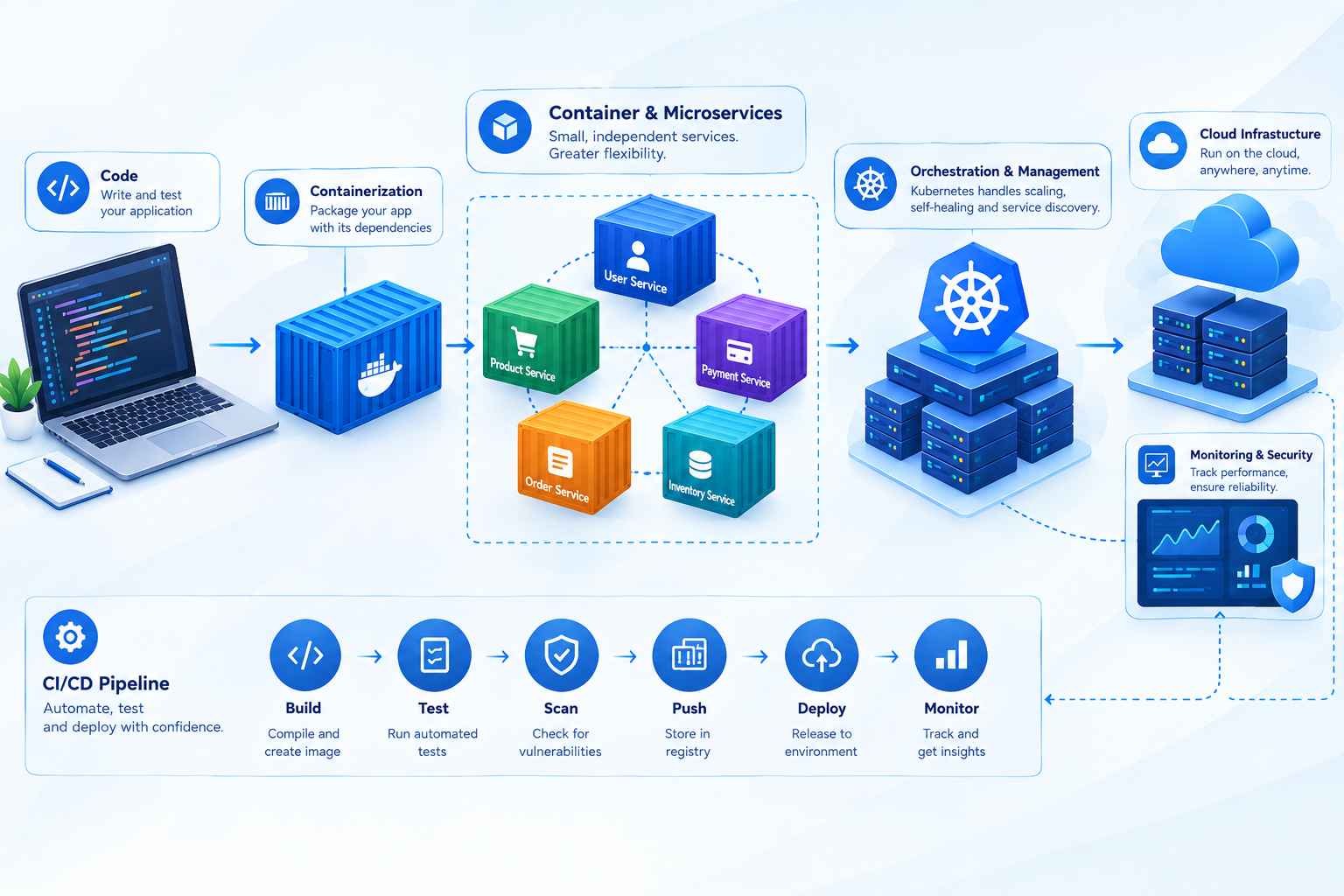
A typical deployment process begins with developers writing and testing code. The application or service is then packaged into a container image. That image is stored in a container registry and deployed to a suitable environment. Configuration, networking, access permissions, and monitoring are applied as part of the deployment process.
For applications containing many services, an orchestration platform can help manage container scheduling, service recovery, scaling, and networking. Kubernetes is a widely used option for this purpose.
However, not every application needs a large orchestration platform. A small application with a few containers may be adequately managed using simpler deployment tools. The right approach depends on operational complexity, reliability requirements, expected traffic, and available technical resources.
The Role of Docker and Kubernetes in Application Deployment
Docker is widely used to build container images and run containerized applications. By defining application dependencies and packaging them together, teams can reduce differences between environments. Docker-based workflows can also make it easier to reproduce development and testing setups.
Kubernetes helps manage containerized workloads across a cluster of machines. It can schedule containers, maintain the desired number of application replicas, support service discovery, and restart workloads when certain failures occur.
For example, if an application experiences increased traffic during a seasonal promotion, its deployment configuration may allow additional replicas to run, subject to available resources and suitable scaling rules. When demand falls, capacity can be adjusted accordingly.
Using Docker and Kubernetes together can support repeatable deployments and more organized workload management. Still, teams must configure resource limits, health checks, networking, security policies, and observability carefully. Poor configuration can lead to unnecessary costs or difficult troubleshooting.
Organizations considering these technologies can evaluate how they fit within their broader Infrastructure Management Services strategy, including cloud resources, server operations, monitoring, and security.
Integrating CI/CD into Container Deployment
Continuous integration and continuous delivery or deployment help automate the steps between code changes and software releases. Instead of relying entirely on manual processes, teams can establish pipelines that build, test, scan, and deploy application changes.
CI/CD Pipeline Services can support a more consistent release process by connecting source control, automated testing, container image creation, image registries, and deployment environments.
A typical container deployment pipeline may include the following steps:
- Code submission: Developers commit changes to a shared repository.
- Automated testing: The pipeline runs unit tests and other relevant checks.
- Image creation: A container image is built from the approved application code.
- Security checks: Dependencies and container images are scanned for known vulnerabilities.
- Deployment: The validated image is released to a staging or production environment.
- Monitoring and rollback: Teams monitor the release and use a defined rollback procedure if serious issues occur.
Automation can reduce repetitive work and improve consistency, but it does not eliminate the need for human review. Production releases still require appropriate access controls, testing standards, approval processes, and recovery plans.
For companies looking to streamline software delivery, combining containerization with DevOps Services can help align development workflows with deployment and operational requirements.
Best Practices for Reliable Container and Microservices Deployment
Successful deployment depends on more than selecting the right tools. Teams need clear standards for building, releasing, securing, and maintaining their applications.
- Keep container images small and maintainable. Use suitable base images, remove unnecessary packages, and avoid including development tools or sensitive files in production images.
- Store configuration outside the application image. Environment-specific settings should be managed separately so the same image can be promoted through different environments. Secrets should be handled through appropriate secret-management mechanisms.
- Define service responsibilities clearly. Each microservice should have a well-understood purpose and stable interfaces. Excessively dividing an application into small services can increase network communication, testing requirements, and operational complexity.
- Apply security throughout the lifecycle. Scan images and dependencies, restrict permissions, protect credentials, and keep container runtimes and orchestration platforms updated.
- Monitor application behaviour. Centralized logs, metrics, traces, and meaningful alerts help teams understand failures and performance bottlenecks across services.
- Plan for failure and recovery. Use health checks, suitable timeouts, retry limits, backups, and tested rollback procedures. Retries should be designed carefully to avoid increasing pressure on an already struggling service.
- Review resource usage regularly. Set appropriate CPU and memory requests and limits where supported. Monitor actual workloads to avoid both overprovisioning and resource shortages.
These practices can improve reliability and maintainability while helping teams control the complexity that comes with distributed applications
Containerization and Application Modernization
Some organizations still operate applications built around older frameworks, tightly coupled components, or deployment processes that require significant manual intervention. Moving directly to a complete microservices architecture may not always be practical.
In many cases, Application Modernization Services can help businesses assess their existing systems and decide which changes are worthwhile. An application might first be packaged into containers without changing its internal architecture. This can simplify environment management while allowing the organization to modernize gradually.
Over time, selected application components may be separated into services where there is a clear technical or business reason to do so. For instance, a frequently updated reporting module could eventually be separated from a larger application if doing so improves deployment independence or supports different scaling requirements.
This incremental approach allows teams to learn from each stage, measure operational results, and avoid introducing unnecessary complexity. It is especially useful when the existing system supports important business operations that cannot tolerate prolonged disruption.
Modernization plans should account for data dependencies, integration requirements, testing effort, application downtime, and the skills needed to maintain the new environment.
Choosing the Right Container and Microservices Approach
Every application has different requirements. A small internal tool may not need the same deployment infrastructure as a high-traffic customer platform. Before choosing a solution, organizations should consider the application's architecture, expected workload, security needs, budget, and internal technical capabilities.
Useful questions include:
- Does the application require frequent releases or independent scaling?
- Are deployment issues caused by inconsistent environments?
- Can the existing application be containerized without major changes?
- Will microservices solve a specific maintenance or scaling problem?
- Does the team have the skills to operate distributed services?
- What monitoring, security, backup, and recovery capabilities are required?
Businesses may also need support from experienced software and infrastructure teams when planning their implementation. Software Development Services can help with application design and engineering. At the same time, IT Resource Augmentation Services can provide additional technical capacity when internal teams need specialized skills for implementation, testing, or deployment.
The goal should be to choose an approach that solves real operational problems rather than adopting technologies simply because they are widely used.
Conclusion
Containerization and microservices have become important approaches to building, deploying, and maintaining modern software. Containers help create consistent application environments, while microservices allow suitable applications to be divided into independently manageable components. Docker, Kubernetes, automated pipelines, monitoring, and security practices can support this process when selected and configured appropriately.
For organizations planning a new application or improving an existing one, the first step is to understand current deployment challenges and define measurable goals. From there, teams can decide whether containerization alone is sufficient or whether a microservices-based design would provide additional value.
With a practical implementation plan, reliable automation, and ongoing operational oversight, Container & Microservices Services can help organizations build a more consistent and manageable application deployment process while keeping future growth and maintenance in mind.
Latest Blogs

What Is the Difference Between AR and VR Development Services?
Augmented Reality (AR) and Virtual Reality (VR) are transfor...
Read MoreSeptember 11, 2026

How AEO, GEO & AI Are Transforming Digital Marketing Services
Search is changing faster than ever. People no longer rely o...
Read MoreSeptember 02, 2026
.png)
Why Businesses Are Moving to Container & Microservices Architecture
As businesses scale their digital operations, traditional ap...
Read MoreAugust 18, 2026
Related Blogs
Why Businesses Are Moving to Container & Microservices Architecture
As businesses scale their digital operations, traditional ap...
August 18, 2026
Read More