The Software That Once Worked Perfectly Might Be Holding Your Business Back
Published on November 13, 2026 | Category: DevOps
Somewhere in your business, there might be an application that everyone knows, everyone uses, and nobody wants to touch.
It has been around for years. It handles important operations. Your employees know its quirks, your workflows depend on it, and your IT team has probably developed a few creative workarounds to keep it running.
It works. Mostly.
But what happens when generating a simple report takes hours? When adding a new feature feels like performing surgery? When your business wants to integrate artificial intelligence, but your existing software behaves as though the internet itself is a suspicious invention?
Suddenly, the software that once made your business efficient starts making progress unnecessarily difficult.
This is where software modernization services become more than a technical upgrade. They become a way to rethink how technology supports your business today—and how prepared it is for tomorrow.
When “It Still Works” Becomes a Dangerous Business Strategy
One of the biggest misconceptions about legacy software is that it becomes a problem only when it completely stops working.
In reality, outdated applications can continue operating perfectly while quietly creating limitations.
Consider a business that manages customer information through an older application. Everything appears fine until the company wants to connect its CRM, automate customer follow-ups, introduce analytics, or expand into new markets.
Suddenly, every new requirement becomes a separate technical challenge.
The application might lack modern APIs, depend on outdated frameworks, or require specialized knowledge that only a few employees possess.
This creates a strange situation: the business is growing, but its technology is asking it to slow down.
A system doesn't need to crash to become a business problem. Sometimes, simply making progress becomes too expensive.
The Hidden Problems Behind Aging Software
Legacy applications rarely announce their limitations dramatically. Instead, they introduce small inconveniences that gradually become operational challenges.
The Feature That Takes Forever to Build
Adding a feature to modern software should ideally be a manageable development task.
With poorly structured legacy applications, however, developers may need to examine thousands of lines of tightly connected code before making even a relatively small change.
One modification might unexpectedly affect another part of the system.
The result? Longer development cycles, increased testing requirements, and higher maintenance costs.
The Integration Headache
Today's businesses rarely operate using a single application.
They depend on websites, CRM platforms, ERP systems, payment gateways, analytics tools, cloud platforms, and automated workflows.
When older software cannot communicate effectively with these systems, employees often become the integration layer.
They manually export spreadsheets, copy information between applications, and repeatedly enter the same data.
Automation is supposed to eliminate repetitive work—not create a sophisticated digital environment where humans spend their afternoons copying and pasting.
The Security Time Capsule
Older applications may depend on unsupported frameworks, outdated libraries, or operating systems that no longer receive security updates.
Even when the application itself appears stable, its underlying technology may introduce vulnerabilities.
Modern security practices, compliance requirements, and infrastructure expectations can become increasingly difficult to implement without addressing these foundations.
The Talent Problem
Technology evolves. Development tools, programming languages, frameworks, and architectural practices change.
Maintaining software built around outdated technologies can become challenging when experienced developers are difficult to find.
The business may eventually depend on a surprisingly small group of people who understand how everything works.
That's not just a technical concern. It's an operational risk.
Software Modernization Isn't the Same as Starting From Scratch
Here's where many businesses get nervous.
The moment someone mentions modernization, decision-makers imagine a massive redevelopment project, months of disruption, expensive replacements, and the possibility of breaking something that currently works.
Understandable. Nobody wants to replace the engine while the car is moving.
But software modernization services don't necessarily mean throwing away an entire application and rebuilding everything from zero.
A smarter approach often involves understanding what should stay, what needs improvement, and what should eventually be replaced.
Different applications require different modernization strategies.
Refactoring: Improving the Code Without Changing Its Purpose
Sometimes, the application performs the right functions but has become difficult to maintain.
Refactoring improves its internal structure, removes unnecessary complexity, and makes the code easier to understand without fundamentally changing what the software does.
Think of it as reorganizing a cluttered workshop. The tools remain useful, but finding and using them becomes much easier.
Replatforming: Moving to Better Foundations
An application may work well but depend on infrastructure that limits performance, scalability, or reliability.
Replatforming moves it to a more suitable environment, such as modern cloud infrastructure, while making relatively limited changes to its core functionality.
This can support better scalability and simplify infrastructure management.
Rebuilding: When the Foundation Needs a Complete Redesign
Some applications have accumulated so many limitations that incremental improvements are no longer practical.
In such situations, rebuilding selected components or redesigning the application architecture may be the better option.
The important part is making this decision based on business requirements rather than automatically choosing the most expensive approach.
What Happens When Old Software Meets Modern Technology?
This is where modernization gets particularly interesting.
Modern applications are expected to do much more than store information or complete transactions.
They need to communicate with other systems, process data intelligently, support digital experiences, and adapt to changing customer expectations.
An appropriately modernized application can create opportunities to introduce:
API integration services: Connect applications with CRM platforms, payment systems, third-party tools, and other business software.
Business Process Automation Services: Reduce repetitive manual work through automated workflows and system integrations.
AI development services: Explore intelligent features such as conversational assistants, document processing, and automated information handling.
Data Science Services: Make business information more useful through analytics, predictive insights, and data-driven decision-making.
Cloud migration services: Move suitable applications and workloads toward scalable, flexible infrastructure.
DevOps Services: Improve collaboration between development and operations teams while supporting faster, more reliable software releases.
Container & Microservices Services: Modernize application architecture where appropriate to improve deployment flexibility and component independence.
The exciting part isn't simply having newer technology.
It's making different technologies work together to solve actual business problems.
Imagine an older inventory application that once required employees to manually prepare reports. After modernization, it could integrate with analytics tools, automate inventory alerts, and provide more timely insights into stock movement.
The application hasn't just become newer. Its role in the business has fundamentally improved.
Modernization Should Begin With Questions, Not Code
Before deciding which technologies to adopt, businesses need to understand what their existing applications actually need.
A practical modernization assessment should explore several important questions:
Which applications create the most operational friction?
What does maintaining the existing software cost compared with improving it?
Which integrations are missing or difficult to implement?
Are security vulnerabilities or unsupported technologies creating risks?
Can the current architecture support future business requirements?
Which modernization activities would deliver measurable value first?
This assessment helps organizations avoid a common mistake: modernizing everything simply because everything looks old.
Sometimes, a targeted improvement delivers more value than an extensive redevelopment project.
Sometimes, an application needs architectural changes.
And sometimes, the best decision is to leave a stable system alone while modernizing the components around it.
The objective is not to make every application look modern. It's to make technology work better for the business.
The Big-Bang Upgrade vs. The Gradual Transformation
One of the most important decisions in legacy application modernization is determining how the transformation should happen.
A complete replacement might sound attractive, but it can introduce significant risks if the business depends heavily on the existing application.
An alternative is incremental modernization.
Instead of replacing everything simultaneously, businesses can modernize individual components, introduce new integrations, and gradually transition functionality.
For example, an organization might:
Modernize its customer-facing interface first.
Introduce APIs to connect existing applications with newer platforms.
Move selected workloads to cloud infrastructure.
Replace outdated components as business requirements evolve.
Improve deployment processes through CI/CD Pipeline Services.
This approach can help organizations maintain operational continuity while progressively improving their technology.
It also allows businesses to learn from each modernization phase before moving to the next.
How Do You Know Modernization Is Actually Working?
A successful modernization project should produce measurable improvements—not simply a newer-looking application.
Businesses should evaluate outcomes such as:
These measurements provide a clearer picture of modernization's actual value.
They also help organizations determine whether additional improvements are necessary.
Your Next Competitive Advantage Might Be Hiding Inside Your Old Software
Businesses often focus their technology investments on exciting new opportunities: artificial intelligence, automation, cloud platforms, and advanced analytics.
But sometimes, the biggest opportunity lies in fixing the technology they already have.
An outdated application might contain years of valuable business logic, operational knowledge, and established workflows. Replacing it without understanding those foundations can be just as problematic as continuing to maintain it indefinitely.
The smarter approach is to recognize what still works, identify what no longer serves the business, and create a practical roadmap for transformation.
With the right software modernization services, organizations can improve application performance, strengthen security, simplify integrations, and prepare their technology for evolving business needs.
At JFS Technologies, businesses can explore technology-led approaches to application modernization, software development, cloud infrastructure, and digital transformation.
Because sometimes, the software holding your business back isn't something you need to abandon completely.
It's something you need to help evolve.
Latest Blogs
Transforming Legacy Systems Without Starting From Scratch
Imagine running a business with software that has been aroun...
Read MoreNovember 05, 2026

Reality Is Great, But Have You Tried the Virtual Version?
Imagine trying a sofa in your living room without buying it,...
Read MoreOctober 29, 2026
.png)
How Full Stack Development Services Help Businesses Build Scalable Applications
In today's competitive digital environment, businesses need...
Read MoreOctober 22, 2026
Related Blogs
How Full Stack Development Services Help Businesses Build Scalable Applications
In today's competitive digital environment, businesses need...
October 22, 2026
Read More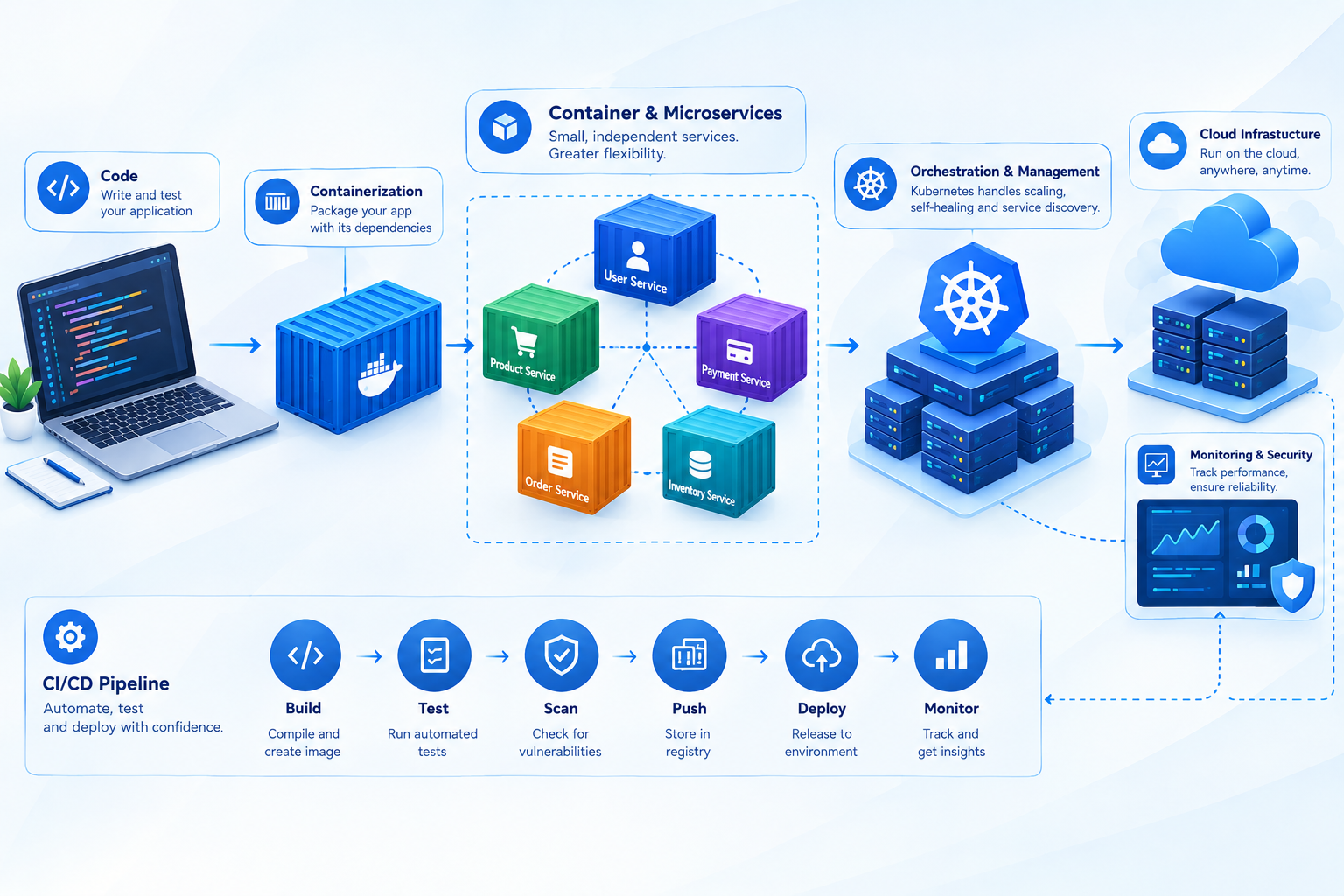
Container & Microservices: A Complete Guide to Application Deployment
Modern applications need to be reliable, flexible, and easy...
October 13, 2026
Read More.png)
Why Businesses Are Moving to Container & Microservices Architecture
As businesses scale their digital operations, traditional ap...
August 18, 2026
Read More