How AI Is Accelerating Application Modernization
.png)
Published on July 06, 2026 | Category: AI/ML
Businesses today face enormous pressure to innovate faster while reducing operational costs. Unfortunately, many organizations still depend on legacy applications that are expensive to maintain, difficult to scale, and vulnerable to modern cybersecurity threats.
This is where Artificial Intelligence (AI) is changing the game.
Rather than replacing software development teams, AI is helping organizations modernize applications more efficiently by automating repetitive tasks, identifying technical debt, improving code quality, enhancing security, and accelerating cloud migration.
Organizations embracing AI-powered application modernization are significantly reducing modernization timelines while improving application performance and customer experience.
At JFS Technologies, our Application Modernisation Services combine AI-driven analysis with expert engineering to help businesses transform outdated applications into scalable, cloud-ready digital solutions tailored to long-term growth.
What Is Application Modernization?
Application modernization is the process of upgrading existing software applications using modern technologies, architectures, and development practices without losing valuable business functionality.
Modernization may include:
- Migrating legacy applications to the cloud
- Refactoring outdated code
- Modernizing UI/UX
- Integrating APIs
- Adopting microservices architecture
- Improving security
- Automating testing and deployment
- Implementing DevOps practices
Unlike rebuilding an application from scratch, modernization preserves existing business logic while making applications faster, more secure, and easier to maintain.
For businesses with aging software, modernization is often the fastest path toward digital transformation.
Why Legacy Applications Are Holding Businesses Back
Many enterprise applications were developed years—even decades—ago.
While they still perform essential business functions, they often create challenges such as:
- High maintenance costs
- Slow software releases
- Limited scalability
- Security vulnerabilities
- Poor customer experience
- Integration difficulties
- Outdated user interfaces
- Lack of cloud compatibility
According to industry trends, organizations spend a substantial portion of their IT budgets simply maintaining legacy systems instead of driving innovation. AI helps shift that balance by making modernization faster and more efficient.
How AI Is Accelerating Application Modernization
1. Intelligent Legacy Code Analysis
One of the biggest modernization challenges is understanding large, undocumented codebases.
AI-powered tools can automatically:
- Analyze millions of lines of code
- Detect obsolete libraries
- Identify technical debt
- Recommend modernization strategies
- Generate architecture documentation
Instead of spending months manually reviewing legacy applications, development teams gain valuable insights in days.
2. Automated Code Refactoring
AI significantly reduces developer effort by suggesting optimized code patterns.
Modern AI coding assistants help developers:
- Refactor outdated code
- Remove duplicate logic
- Improve readability
- Optimize performance
- Recommend best practices
Developers remain in control while AI handles repetitive coding tasks, increasing productivity and reducing human error.
3. Faster Cloud Migration
Cloud migration is a core component of application modernization.
AI simplifies migration by:
- Assessing cloud readiness
- Recommending cloud architecture
- Predicting migration risks
- Optimizing workloads
- Automating infrastructure configurations
Businesses moving applications to AWS, Azure, or Google Cloud can achieve better scalability, resilience, and cost efficiency.
4. Smarter API Integration
Modern businesses rely on interconnected systems.
AI assists developers by:
- Identifying integration opportunities
- Mapping data between applications
- Detecting API compatibility issues
- Generating API documentation
- Automating testing
This enables organizations to integrate CRM, ERP, payment gateways, analytics platforms, and third-party services with greater speed and reliability.
5. Predictive Security Improvements
Security has become one of the most important aspects of modernization.
AI continuously scans applications to identify:
- Vulnerable dependencies
- Misconfigurations
- Security gaps
- Potential attack vectors
- Compliance risks
Rather than waiting for vulnerabilities to be exploited, AI helps organizations proactively strengthen application security.
6. Enhanced Testing Automation
Traditional software testing is often time-consuming and resource-intensive.
AI improves testing by:
- Automatically generating test cases
- Prioritizing high-risk scenarios
- Detecting anomalies
- Reducing regression testing effort
- Identifying UI issues
This enables faster software releases with greater confidence.
7. Better User Experience Through AI
Application modernization isn't just about technology—it’s also about users.
AI analyzes user behavior to identify:
- Navigation bottlenecks
- Frequently abandoned workflows
- Performance issues
- User preferences
These insights help businesses redesign interfaces that improve engagement and customer satisfaction.
Benefits of AI-Powered Application Modernization
Organizations adopting AI-driven modernization experience multiple business benefits, including:
- Faster modernization projects
- Reduced operational costs
- Improved developer productivity
- Better application performance
- Enhanced cybersecurity
- Increased scalability
- Improved customer experiences
- Faster software delivery
- Reduced technical debt
- Future-ready infrastructure
These advantages enable businesses to remain competitive while responding more quickly to market demands.
Industries Benefiting from AI Application Modernization
AI-powered modernization is transforming organizations across sectors:
Healthcare
- Secure patient portals
- Modern hospital systems
- AI-assisted diagnostics integration
Financial Services
- Core banking modernization
- Fraud detection integration
- Faster digital lending platforms
Manufacturing
- IoT-enabled applications
- Predictive maintenance systems
- Smart factory integrations
Retail & E-commerce
- Personalized shopping experiences
- Inventory automation
- Cloud-native commerce platforms
Education
- Learning Management Systems
- Student analytics
- Virtual classrooms
Logistics
- Fleet optimization
- Warehouse automation
- Real-time tracking platforms
Common Challenges During Application Modernization
Although AI accelerates modernization, successful projects still require strategic planning.
Common challenges include:
- Legacy architecture complexity
- Data migration risks
- Business continuity concerns
- Integration with existing systems
- Employee adoption
- Compliance requirements
This is why experienced modernization partners remain essential throughout the transformation journey.
Best Practices for AI-Driven Application Modernization
Organizations should follow these proven practices:
- Assess existing applications before modernization.
- Prioritize business-critical systems.
- Adopt a phased modernization approach.
- Use cloud-native architecture where appropriate.
- Integrate DevOps and CI/CD pipelines.
- Automate testing wherever possible.
- Continuously monitor application performance.
- Strengthen cybersecurity from the start.
- Leverage AI for code analysis and optimization.
- Work with experienced modernization experts.
Why Choose JFS Technologies for Application Modernization?
At JFS Technologies, we help businesses modernize legacy applications using a strategic blend of AI, cloud technologies, automation, and engineering expertise.
Our capabilities include:
- Legacy Application Assessment
- Application Modernisation Services
- Cloud Migration & Optimization
- API Integration
- UI/UX Modernization
- Performance Optimization
- Security Enhancement
- DevOps Enablement
- Scalable Cloud Architectures
Every modernization roadmap is tailored to your business goals, ensuring minimal disruption while improving scalability, security, and long-term maintainability.
Frequently Asked Questions
What is AI-powered application modernization?
AI-powered application modernization uses artificial intelligence to automate code analysis, optimize legacy systems, improve security, accelerate cloud migration, and streamline software modernization projects.
Can AI replace software developers during modernization?
No. AI assists developers by automating repetitive tasks, generating recommendations, and improving productivity, while experienced engineers continue to make architectural and business decisions.
What are the benefits of application modernization?
Application modernization improves scalability, security, performance, user experience, maintainability, and integration capabilities while reducing long-term operational costs.
How long does application modernization take?
Project timelines vary depending on application complexity, technology stack, and modernization goals. AI can significantly reduce assessment, coding, testing, and migration time compared to traditional approaches.
Should businesses modernize or rebuild applications?
In many cases, modernization offers a more cost-effective and lower-risk approach than rebuilding from scratch because it preserves valuable business logic while upgrading technology.
Latest Blogs
.png)
How Full Stack Development Services Help Businesses Build Scalable Applications
In today's competitive digital environment, businesses need...
Read MoreOctober 22, 2026
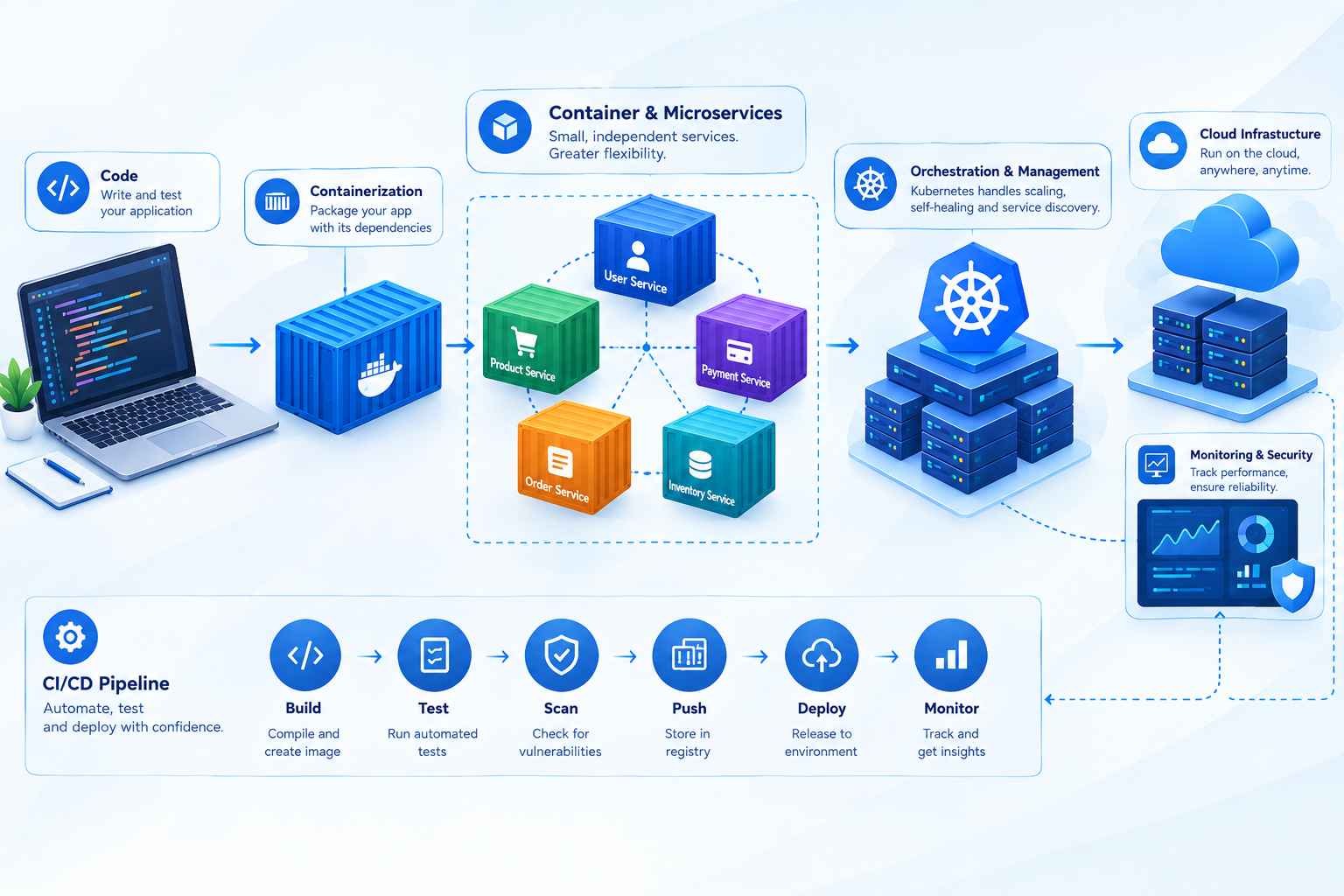
Container & Microservices: A Complete Guide to Application Deployment
Modern applications need to be reliable, flexible, and easy...
Read MoreOctober 13, 2026

What Is the Difference Between AR and VR Development Services?
Augmented Reality (AR) and Virtual Reality (VR) are transfor...
Read MoreSeptember 11, 2026
Related Blogs
.png)
How AI Is Transforming Digital Marketing Services
Digital marketing has always evolved alongside technology. F...
August 03, 2026
Read More.png)
How AI is Transforming Digital Transformation
Digital transformation is no longer a corporate buzzword - i...
September 05, 2025
Read More.png)
How AI is Transforming Customer Experience
Digital marketing has always evolved alongside technology. F...
September 05, 2025
Read More